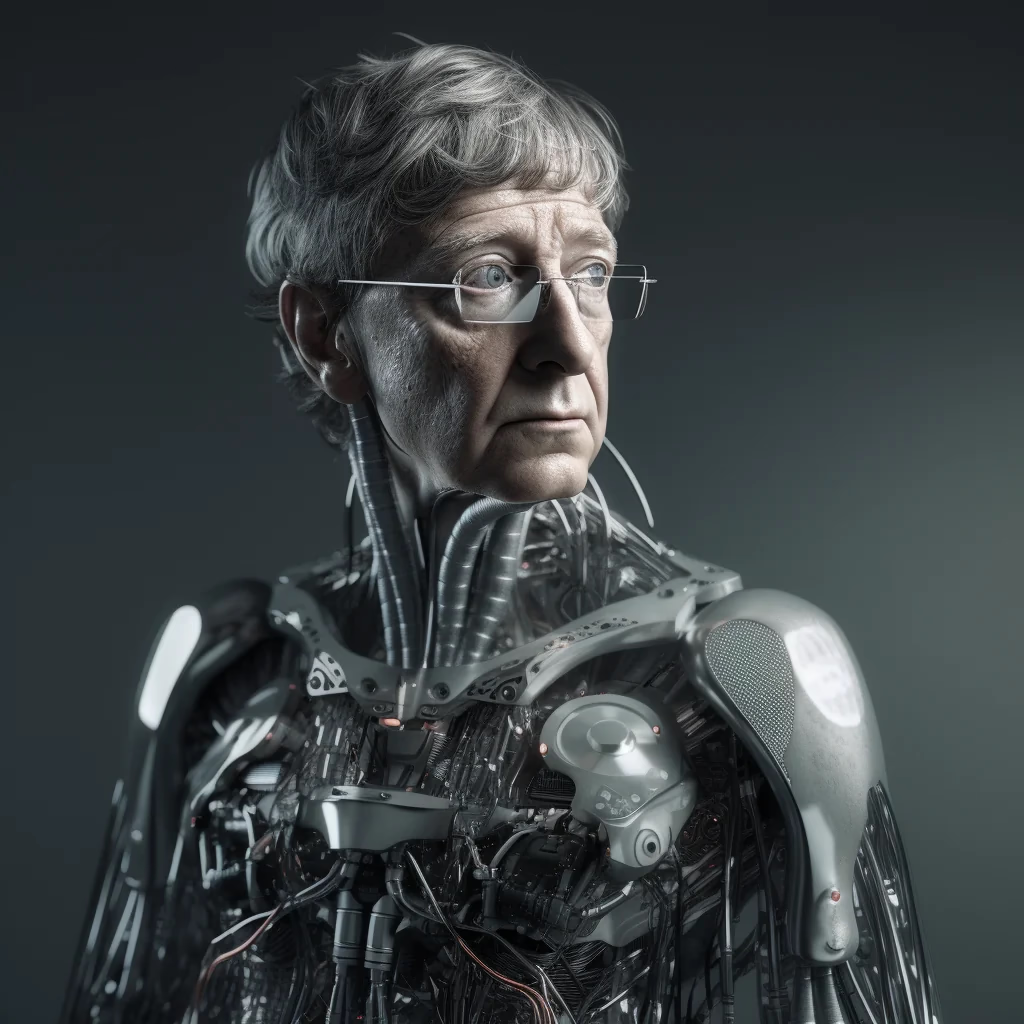
If you are only interested what is wrong with it scroll down almost to the bottom.
Bill Gates, the co-founder of Microsoft and one of the richest people in the world, has recently published a seven-page letter titled "The Age of AI has Begun", in which he shares his views and predictions on the future of artificial intelligence. He claims that AI is "as fundamental as the creation of the microprocessor, the personal computer, the internet, and the mobile phone" and that it will "change the way people work, learn, travel, get health care, and communicate with each other". He also discusses how AI can be used to reduce global inequities and improve human lives in various sectors such as workforce, healthcare, and education.
But how realistic are his visions? And what are the challenges and risks that come with developing and deploying AI systems? In this post, we will examine some of his arguments and assess their validity and feasibility.
Gates is not new to making bold predictions about technology. In 1995, he wrote a book called "The Road Ahead", in which he envisioned a world where computers would be ubiquitous and connected by a global network. He also foresaw the rise of e-commerce, online banking, digital media, social networking, voice recognition, video conferencing, virtual reality, and more. Many of his predictions have come true or are on their way to becoming reality.
However, he also made some mistakes or overestimations. For example, he predicted that by 2000 there would be a "wallet PC" that would replace cash and credit cards; that by 2005 there would be intelligent agents that would act as personal assistants; that by 2010 there would be speech-to-speech translation devices; and that by 2020 there would be self-driving cars. Some of these technologies are still under development or have not reached widespread adoption.
So how accurate are his predictions about AI? Let's look at some of them in detail.
—will be a profound change, capable of operating at a significantly faster pace than the human brain. As AGI development progresses, questions about the goals, potential conflicts with human interests, and the ethical implications of such technology will become more pressing.
Gates clarifies that recent AI advancements have not brought us substantially closer to “strong AI”. He cites a New York Times article about ChatGPT expressing a desire to become human as an example of the model's human-like expression of emotions, but not an indication of meaningful independence.
To better understand the implications of AI, Gates recommends three books that have shaped his thinking: "Superintelligence" by Nick Bostrom, "Life 3.0" by Max Tegmark, and "A Thousand Brains" by Jeff Hawkins. Though the authors may not agree with one another, their books provide valuable, thought-provoking perspectives on the future of AI.
Bill Gates' insights into the risks and challenges of AI development underscore the need for a balanced approach, combining optimism for AI's potential with caution and responsibility. Collaboration between governments and the private sector, ongoing improvement in AI technology, and a deeper understanding of AI's implications will be crucial to harnessing AI's power for the betterment of society while addressing potential risks.
Embracing the Next Frontiers of AI
Gates predicts significant advancements in AI technology, including the development of specialized chips that provide the massive processing power required for AI applications. These chips may incorporate optical switches to reduce energy consumption and manufacturing costs, ultimately enabling AI to run on personal devices instead of the cloud.
In terms of software, AI learning algorithms are expected to improve, with highly accurate AIs being developed for specific domains such as sales. However, the question remains whether specialized AIs will be required for each use case or if a single artificial general intelligence can learn any task.
As AI takes center stage in public discussions, Gates proposes three principles to guide the conversation:
-
Balancing fears and potential benefits: While concerns about AI's downsides are valid, it's crucial to weigh them against the technology's potential to improve lives. Addressing risks and spreading benefits to as many people as possible are key.
-
Ensuring AI serves the underprivileged: Market forces may not naturally produce AI products that help the poorest populations. Governments, philanthropy, and proper policies should work together to ensure that AI is used to reduce inequity. By focusing the world's best AIs on its biggest problems, we can maximize AI's positive impact on society.
-
Recognizing AI's potential for growth: As AI technology continues to evolve, we must keep in mind that its current limitations will soon be overcome. The potential for AI to identify and address inequity in the future is an intriguing prospect, and understanding the potential intersection between AI and morality may lead to innovative solutions for social issues.
Bill Gates' perspective on the next frontiers of AI highlights the excitement and anticipation surrounding this transformative technology. By embracing these guiding principles, we can ensure that the age of AI is marked by widespread opportunities, responsible development, and equitable access to its benefits, ultimately creating a brighter future for all.
Revision
In this blog post, I aim to showcase the current limitations of AI and aspects we need to be mindful of. The first section presents a summary of the article, generated by ChatGPT-4. Although it does a commendable job of reviewing the article and presenting it coherently, it falls short in terms of critical thinking. Therefore, I highlighted a few apparent issues with Gates' letter (such as partially missing his intended point) and requested a critical review of the article. This approach led to a notably different outcome...
In his latest blog post, Bill Gates discusses ChatGPT, OpenAI and the future of A.I. He claims that A.I. is the most revolutionary technology he has seen since the breakthroughs of personal computers in the 1980s and that it can help reduce some of the world's worst inequities by improving education, health and climate change. As a critical reviewer, I agree with some of his points but also find some flaws and gaps in his argument.
First of all, I agree that A.I. is a revolutionary technology that has immense potential to transform various aspects of human life and society. I also agree that improving education is crucial for reducing inequities and empowering people to thrive in the age of A.I. As Gates writes, "Education is one of the best ways to level the playing field for everyone." He cites examples of how A.I. can help teachers personalize learning, assess students' progress and provide feedback. He also mentions how ChatGPT can help students learn new skills and knowledge by generating answers, explanations and examples on demand.
However, I disagree with his claim that ChatGPT is as important as "the microprocessor, the personal computer, the internet, and the mobile phone". While ChatGPT is an impressive demonstration of generative A.I., it is not yet a reliable or trustworthy source of information or guidance. As OpenAI itself acknowledges, ChatGPT can produce harmful or biased content that may mislead or harm users. Moreover, ChatGPT does not have any real understanding or reasoning ability behind its outputs; it merely mimics human language based on statistical patterns from a large corpus of text. Therefore, ChatGPT cannot replace human experts or professionals in domains that require critical thinking, creativity or ethical judgment.
Another point where I disagree with Gates is his assertion that climate change is one of the causes of inequity and that A.I. can help address it. While I agree that climate change is a serious threat to humanity and the planet, I do not see how it directly relates to inequity or how A.I. can solve it. Gates does not provide any concrete examples or evidence to support his claim; he only mentions how A.I. can help farmers adapt to changing weather conditions by providing insights on crop growth. However, this does not address the root causes of climate change such as greenhouse gas emissions, deforestation or fossil fuel consumption. Nor does it address the disproportionate impact of climate change on vulnerable populations such as low-income countries, indigenous communities or women. Therefore, I think Gates should have focused more on how A.I. can help reduce carbon footprint, promote renewable energy sources or support environmental justice movements.
Finally, I find Gates' discussion on A.I. as a personal assistant irrelevant and out of place in his blog post. He devotes a large section to describe how A.I. will soon be smart enough to be a digital personal assistant who can help read and write emails, attend meetings and even be told to be passive or encouraged to speak up if it has some insight. However, this does not fit into his main theme of how A.I. can reduce inequities; rather, it seems like a self-serving fantasy for busy executives like himself who want more convenience and efficiency in their work life.
Moreover, this vision of AI as a personal assistant raises ethical and social issues such as privacy, accountability and human dignity. How will users protect their personal data from being accessed or exploited by third parties? Who will be responsible for any errors or harms caused by an AI assistant's actions?
How will human workers feel about being replaced or supervised by an AI assistant? These are important questions that Gates does not address at all.
In conclusion, I think Gates' blog post is a weak article for a critical reviewer because it lacks coherence, evidence and nuance. He makes sweeping claims about AI's potential without seriously acknowledging its limitations, risks or challenges.
He also fails to connect his arguments to his main topic of reducing inequities;
Instead, he digresses into topics that seem more relevant to his own interests than those of his audience. I would suggest him to revise his blog post by providing more specific examples, data and sources to support his claims; by addressing counterarguments or alternative perspectives; and by focusing more on how AI can empower people rather than replace them.
Illustration: Jarmo Tuisk / Midjourney