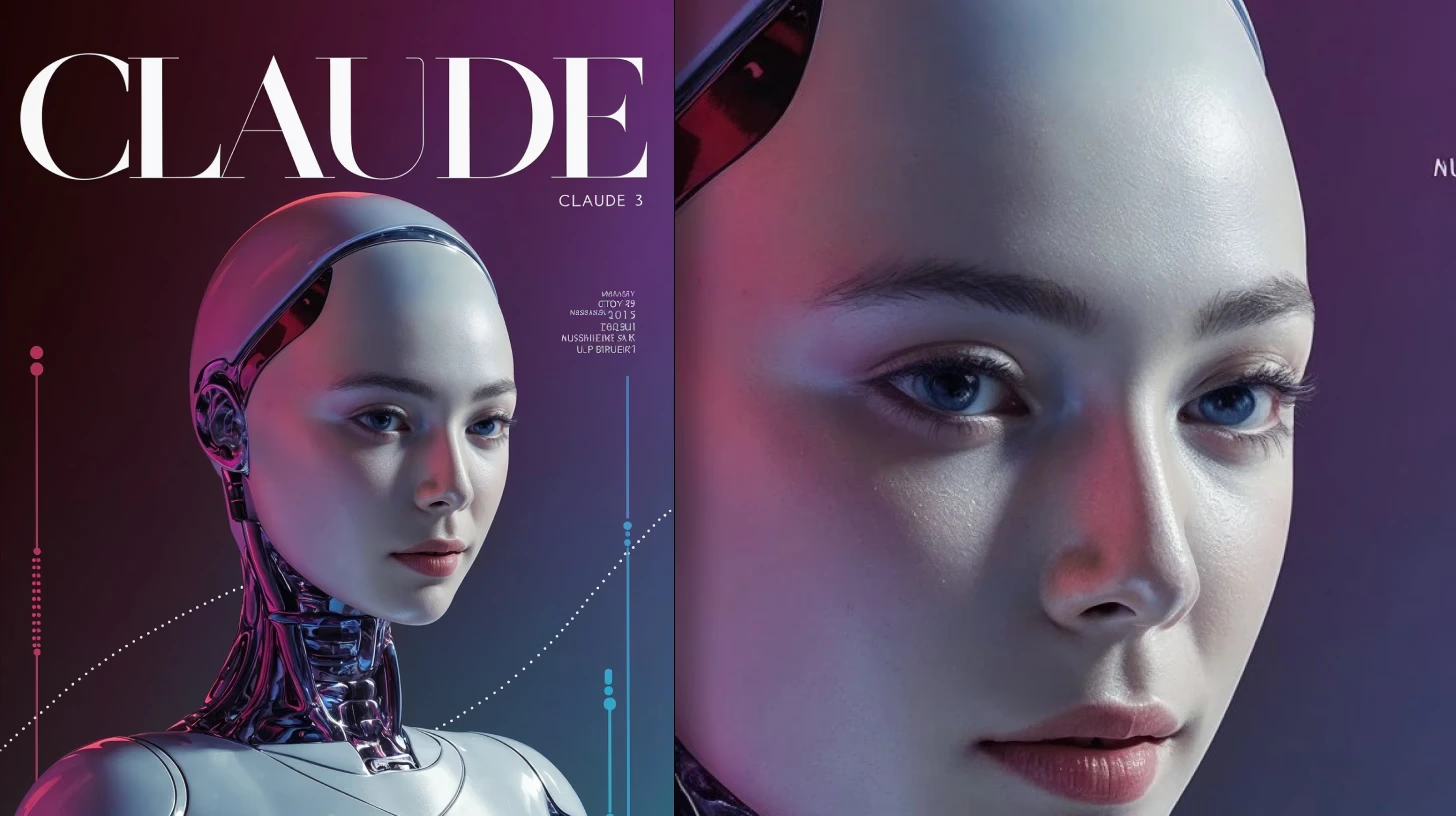
On March 4th, Anthropic unveiled their new model family Claude 3. The Claude 3 model family consists of three different models:
* Claude 3 Haiku
* Claude 3 Sonnet
* Claude 3 Opus
Each subsequent model is more powerful than the previous one, giving users the ability to find the optimal balance between intelligence, speed, and price according to their specific needs.
Opus and Sonnet are now available on the claude.ai platform and through the Claude API in 159 countries. Haiku will also become available soon.
Claude 3 Opus is the most intelligent model in the family, surpassing the benchmarks of most artificial intelligence systems to date, including bachelor's level domain knowledge (MMLU), master's level reasoning ability (GPQA), elementary mathematics (GSM8K), and much more. It demonstrates near-human comprehension and expression abilities for complex tasks, pushing the boundaries of general intelligence.
All Claude 3 models are more capable in terms of analytical and predictive ability, nuanced content creation, code generation, and communication in Spanish, Japanese, French, and other languages.
Haiku is the fastest and most cost-effective model in its intelligence category on the market. It can process a research paper on the arXiv database (~10,000 characters) with diagrams and graphs in less than three seconds.
Sonnet is twice as fast as Claude 2 and Claude 2.1 for most workloads while offering higher intelligence. Opus offers similar speed to Claude 2 and 2.1 but at a significantly higher level of intelligence.
The Claude 3 models also have advanced visual analysis capabilities comparable to other leading models. They can process various visual formats, including photos, graphs, tables, and technical drawings.
Of these, the benchmarks for the most powerful one, Opus, indicate that for the first time, a large foundational model more powerful than any currently available OpenAI model has been made accessible to regular users.
Initially, we can only rely on Anthropic's own measurements, as independent verification is still pending.
 cannot release models more capable than GPT-4, even if they already exist.
This situation likely made it possible for Claude 3 to currently be the best large multimodal model, and Sam Altman cannot do anything about it. It would be nice, of course, if I'm wrong and we get to try GPT-5 at the beginning of next week ;)
You can read more about Elon Musk's case here:
https://buff.ly/49wjlAD
PS. The illustrative image was created using the new image AI model/app Ideogram 1.0, which can currently combine text and images better than other models on the market.
PPS. I improved the Ideogram-made image with Magnific.ai, which significantly enhances image detail and improves quality.